


There is some confusion as to where William was born as some military records say Woodham Ferrers and the 1901 census indicates Rettendon. This is further complicated as it has not been possible to track down a registration of a birth in the name of William Havis. A further complication is that the Commonwealth War Graves Commission lists his father as Albert but all else indicates that he was Alfred and that his mother was Alice. Further investigation shows that Alfred Havis married Alice Barnes early in 1889. There is a birth registered for William Havers son of Alfred Havers and his wife Alice nee Barnes 23rd May 1891 at Rettendon which must be our William with his family name misspelt.
William married Kate Barker of Wix, Manningtree who was working as a domestic servant at Redhouse in Wix. They married at All Saints Church in Dovercourt on 9th October 1915 not long before William landed in France.
William volunteered for the army and joined the 9th (Service) Battalion, The Essex Regiment
one of Kitchener’s First New Army volunteer battalions which was formed in August 1914. William joined the battalion in France on 1st December 1915 where it formed part of the 35th Brigade, 12th (Eastern) Division. What we now remember as The Battle of The Somme began on 1st July and the division including the 9th Essex was ordered to attack Ovillers in the Battle of Albert part of the Somme offensive on the 3rd July.The records show that William and his mates came under heavy artillery fire even before they got to the British front line and were subject to heavy machine gun fire from both flanks and the trenches ahead. Sadly William was one of the 110 men from the battalion killed in action during the attack.
The war diary for the battalion reads
3 July 1916:
2.15am - All was reported ready. Zero ( time of assault) was altered to 3.07am about midnight. A heavy bombardment of OVILLERS by our artillery was carried out during the afternoon & night preceeding the attack.
The enemy's retaliation was insignificant up till midnight when his bombardment increased and became heavy from about 3am especially on the CTs [communication trenches] to the front & support lines
3.07am - The leading waves of the Berks & Suffolks left our lines
3.20am - The 1st lines of the Bn [Battalion] followed in pursuit
The Berks & Suffolks went right over the enemy’s front and support lines & some troops entered the village together with the leading lines of the Bn which had come up in support.
The Bn suffered severely during the advance across the open from MG [machine gun] fire from either flank and from the village
The troops were unable to hold their ground and were driven out by bombing and MG suffering very heavily in getting back.
The last line of the Bn was checked in front of the strong point on a terrace and overlooking the German front line across the road leading into the village from a SW direction on AVELUY -OVILLERS Road.
4.30pm - The attack on OVILLERS came to a stand still about 4.30pm and the remainder of the 3 Btns withdrew inside their lines.
Casualties were 12 officers 386 ORs [other ranks]wounded missing & killed.
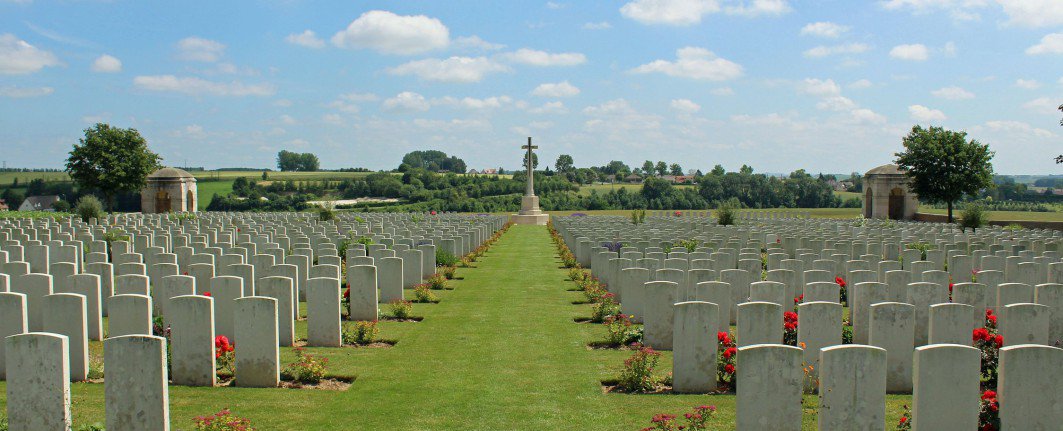
William lies at rest in Ovillers Military Cemetery in Picardie, Northern France where he is remembered as the son of Albert (sic) Havis and husband of Kate Havis of Wix Green, Maningtree. The cemetery contains the graves of 3,440 Commonwealth soldiers.
William’s married life with Kate proved to be very short and to add to the tragedy Kate gave birth to their daughter Ivy Irene Kate on 17th July 1916 just two weeks after William’s death.
Kate died in 1933. Ivy married Herbert Cotterill in 1937 and died in 1982.
William was awarded the 1914-15 Star, the British War Medal and the Victory Medal.